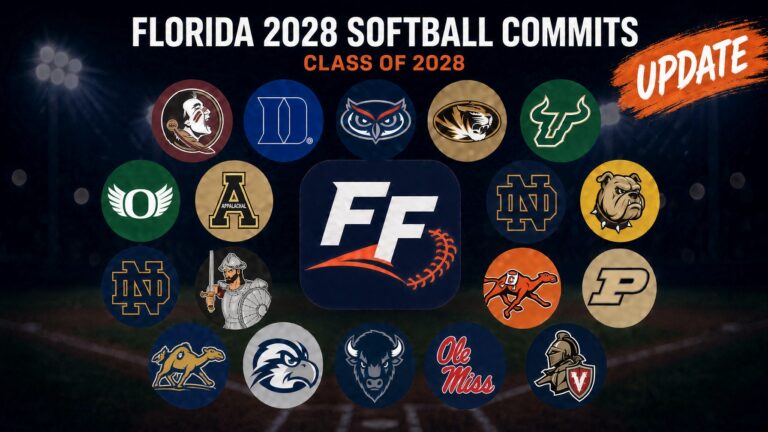
For the Class of 2028, one of the biggest dates on the softball recruiting calendar arrives in a college game that is changing almost as quickly as the recruiting process itself.
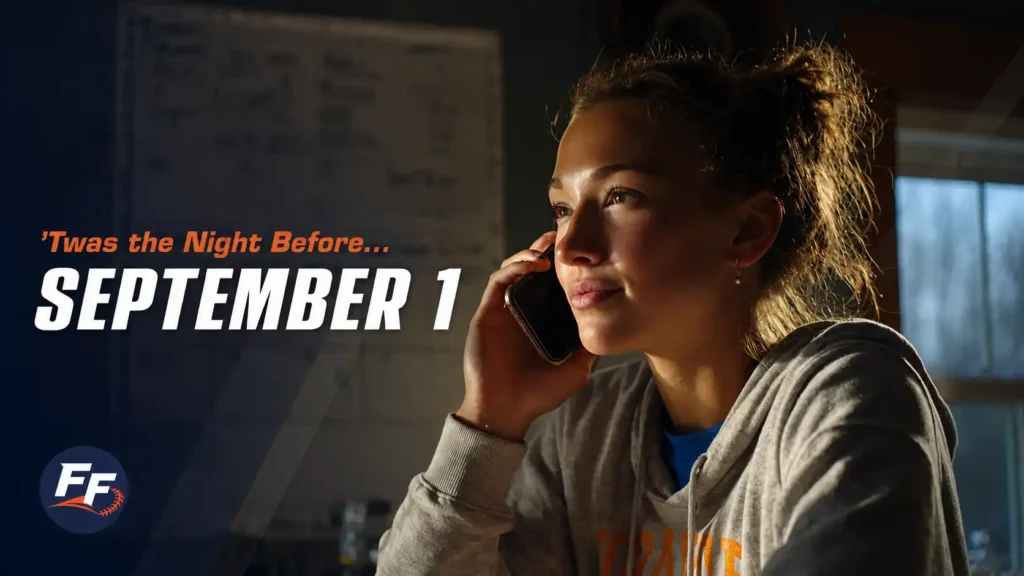
Somewhere in Florida tonight, a 2028 softball player is going to check her phone battery three times before bed.
Her parents might ask whether the ringer is turned on. Her travel coach probably has a pretty good idea which schools have shown the most interest. There will be players trying not to think about tomorrow and families pretending they are not thinking about it at all.
And somewhere along the way, somebody will probably open social media and immediately begin wondering why another player seems to be getting more attention.
It is the night before September 1.
For years, September 1 of a player's junior year has carried an almost mythical status in Division I softball recruiting. It is the date when much of the wall between college coaches and recruits finally comes down and direct recruiting conversations can begin.
This year, though, there is a change right from the start.
Nobody needs to stay awake until midnight.
Beginning September 1, 2026, Division I softball's opening time for recruiting correspondence, telephone calls, off-campus contacts and athletics-involved campus visits is 1 p.m. Central, or 2 p.m. Eastern here in Florida. The NCAA adopted the specific start time this summer, ending the old race to make contact in the overnight hours.
So get some sleep.
That may actually be the easiest part of the next 12 months.
September 1 Is a Starting Line, Not a Finish Line
There is no question that September 1 matters.
Some coaching staffs already know exactly which 2028s they want to call. They have watched those players during the summer, tracked their development, talked with travel coaches, and worked through their recruiting boards. For those recruits, Tuesday afternoon could move quickly.
But that is not everyone's recruiting story, nor does it need to be.
September 1 is permission for coaches to begin a conversation. It is not a requirement that every coaching staff finish its recruiting class in 48 hours.
A school may really like a player but want to see her again this fall. A coach may be interested in two or three athletes at the same position and need more time to determine who fits best. Another program may be sorting through academics, roster needs or exactly how many players it wants to take in the class.
That is why judging your recruiting process by what happens during the first few hours of September 1 is a bad idea.
Social media will make that difficult.
You are going to see screenshots of phone calls. You will see visits announced, offers posted and eventually the first commitments from the class. What you will not see nearly as often are the hundreds of good players whose recruiting is moving forward quietly, one conversation at a time.
A phone that does not ring at 2:01 p.m. does not suddenly make you a different softball player than you were at 1:59.
By the same token, getting five calls tomorrow does not mean the process is finished.
It means you have five conversations to start.
This Class Is Entering a Different College Softball World
The Class of 2028 is also entering the recruiting process at an interesting time.
College softball roster construction has changed dramatically over the past few years, and the players being recruited now will arrive on campuses under rules different from those faced by many of the players currently wearing college uniforms.
Start with what most people in softball have come to call the "5 for 5" rule.
That nickname is useful, but it is not technically how the NCAA defines the rule. The new Division I model is based on age and enrollment timing and generally creates a continuous five-year eligibility period for athletes who meet the requirements. For prospects who initially enroll full-time in college in fall 2027 or later, the age-based model applies rather than the old system built around four seasons of competition within a five-year clock. The NCAA specifically cautions that "5 for 5" does not mean five seasons are automatically guaranteed to every athlete, particularly when enrollment is delayed.
For the typical 2028 high school graduate heading directly to college, though, the practical effect could be significant.
More players may have the ability to remain on college rosters longer.
Now combine that with the roster limits introduced after the House settlement. Division I softball programs subject to those settlement roster rules have a 25-player limit.
Twenty-five sounds like a decent-sized roster until you start trying to build one.
A coaching staff needs pitchers and catchers. It needs middle infielders, corners and outfielders. It needs offense, defense, speed, power and depth. Coaches also need to think about injuries, player development and whether athletes can handle more than one position.
Then they have to figure out how many current players will return, how many years those players can remain, which freshmen are already committed and what immediate needs might eventually be filled through the transfer portal.
That makes the roster puzzle more complicated.
It does not mean high school recruiting is disappearing.
It means coaches have to be more precise.
The Transfer Portal Changed the Math Too
The portal is now part of roster construction, whether recruits like it or not.
If a college staff realizes after the season that it needs an experienced pitcher immediately, it has another option besides waiting for a high school pitcher to arrive and develop. If a program loses an infielder unexpectedly, it can look for a college player who already has experience at that level.
Beginning with the current rules, Division I softball has two notification-of-transfer windows: December 1 through December 15 and another 15-day period beginning the day after the Division I championship concludes.
For high school recruits, the important part is not memorizing portal dates. It is about understanding what the portal has done to the way coaches think.
Recruiting is no longer simply a staff looking three years ahead and saying, "We need a shortstop in the 2028 class."
The conversation might be more like this:
Who will still be here in 2028? How much eligibility will those players have left? Do we have a 2027 at that position? Can one of our current athletes move positions? Is there a player in the portal who could solve an immediate problem? How many freshmen can we realistically bring onto a 25-player roster?
That is why recruiting can move differently from one school to another, even when both schools genuinely like the same player.
One program might have a clear opening.
Another might simply have nowhere to put her.
That distinction matters.
Do Not Turn the Next Year Into a Camp Tour
Once September 1 passes, camps will become an even bigger part of the conversation. They can be one of the best opportunities for a player to get in front of a coaching staff that wants another look.
They can also get very expensive very quickly.
Before registering for a camp, especially one that requires airfare, hotels or a long drive, have your travel coach contact the school.
There is a simple question worth asking:
Is there legitimate recruiting interest in this player?
That does not mean a college coach has to promise an offer before you attend. Maybe she tells your travel coach they have watched you and want to evaluate you more closely. Maybe he says the staff likes your bat but wants to see you defensively. Maybe a pitching coach wants to work with you in person before deciding where you sit on the recruiting board.
Those are useful answers.
They tell you there is a reason to be there.
But if your travel coach contacts a program and there is little or no indication that the staff is recruiting you, think carefully before spending another $1,000 on a weekend simply because the school name looks good on a camp T-shirt.
Not every camp needs to lead to an offer. Camps can be useful for development and exposure too. Just know why you are attending before you pay for it.
There is a big difference between going to a camp because a coaching staff wants another look and going to a camp hoping somebody notices you for the first time.
Now You Get to Be Part of the Conversation
For years, much of this process has happened around the player.
Travel coaches have communicated with college coaches. Players have sent emails and schedules. College staffs have watched games from behind the backstop while recruits tried not to look over every five minutes to see who was standing there.
After September 1, the relationship becomes much more direct.
Take advantage of that.
If a coach contacts you, respond. If a program asks you to keep the staff updated, actually keep the staff updated. Send your fall schedule. Share useful video. Let coaches know when you will be playing somewhere they can evaluate you. Update them when something significant changes academically or athletically.
You do not need to send a five-paragraph email every week just to stay visible.
Good communication is better than constant communication.
There is also another side of September 1 that players sometimes forget: you can finally start learning more about the schools too.
Ask questions.
Where does the staff see you playing?
How many players are they looking to take in the 2028 class?
What does the current depth chart look like at your position?
How does player development work?
What is the academic support like?
Does the university actually offer what you want to study?
What does a normal week look like for a softball player there?
With roster limits, the portal and potentially longer eligibility for current players, it is also perfectly reasonable to ask how the staff sees you fitting into the roster when you arrive.
You are not being difficult by asking.
You are making a college decision.
The Most Important Part Might Be the Next 12 Months
Tomorrow gets the attention because it is easy to put a date on a calendar.
The next year is harder to package into an Instagram post, but it will probably matter more.
A lot can happen between September 1 of your junior year and September 1 of your senior year.
You can get stronger. Your velocity can improve. Your swing can change. You can become more consistent defensively. You can improve your speed, develop another pitch, raise your grades or simply become a much better softball player.
College recruiting boards can change too.
A player a program expected to land commits somewhere else. A current college athlete leaves. Another decides to return. A coach sees a 2028 in October and likes her much more than she did in June. A recruit discovers the school she thought she wanted is not a good fit after visiting campus.
None of that is unusual.
That is why players who do not get the response they hoped for on September 1 should resist the urge to start changing everything by September 3.
Look at your school list honestly. Talk with your travel coach. Find out where there is real interest and where you may need to create more. Continue developing as a player and be willing to expand your list.
There is a lot of good college softball beyond the first ten schools that come to mind.
Look Beyond the Logo
This may be more important now than ever.
When recruiting starts moving quickly, it is easy to become consumed with who called, which conference a school plays in or how impressive the logo will look on a commitment graphic.
Eventually, the graphic goes away.
Then you have to live there.
Look at the school itself. Does it have the academic program you want? Can your family make the finances work? Do you like the size of the campus? How far from home do you really want to be? What kind of relationship do the players have with the coaching staff?
And look at the softball roster.
If you are a catcher, who else is there? If you are a pitcher, how many pitchers does the program normally carry? Which players could still have eligibility when you arrive? Has the staff already committed someone at your position in another class?
You should expect to compete for playing time. That is college athletics.
But there is a difference between earning your way onto the field and ignoring obvious information that was available before you committed.
Ask questions now.
And Finally, Enjoy September 1
With all the talk about roster limits, eligibility rules, the portal and recruiting strategy, it is easy to make September 1 sound like a business transaction.
It isn't entirely that.
For a lot of players, tomorrow is going to be really exciting.
These are athletes who have spent years at practices, lessons, workouts and tournaments. Their families have driven thousands of miles. They have played in the heat, sat through rain delays and spent more weekends at softball complexes than they probably care to count.
Some of them are going to answer a phone tomorrow and see the name of a school they have hoped to hear from for years.
Enjoy that moment.
If one school calls, enjoy the conversation.
If five call, enjoy those too.
And if the phone is quieter than you hoped, go to practice.
There is still a lot of recruiting ahead.
September 1 does not determine how good you are, and it certainly does not determine what kind of college career you will eventually have. What it does is give you information about where your recruitment stands today.
Use that information.
Keep developing. Keep communicating. Be smart about camps. Listen to your travel coach. Ask college coaches good questions. Make sure the schools recruiting you actually fit what you want from college, not just what you want your commitment announcement to say.
Most of all, remember that the goal was never to win September 1.
The goal is to find the right place to play college softball.
And when you do find it, we want to know.
Once you commit, complete the Florida Fastpitch Commitment Form so we can add you to our Commitment Tracker and help celebrate the next step in your softball journey.
Tomorrow the calls begin.
For the Class of 2028, the interesting part comes next.
Submit your commits here