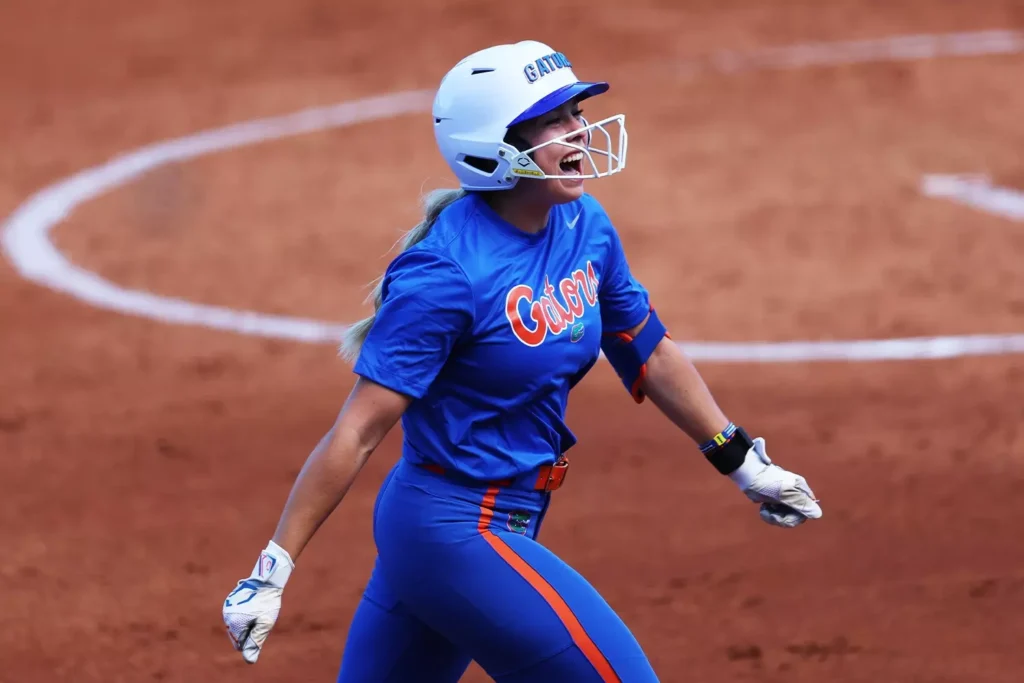
Florida opens 2026 with a familiar label and a very different roster. The Gators start No. 6 in the ESPN.com/USA Softball preseason Top 25, coming off a 48-win 2025 that ended with the program’s 13th trip to the Women’s College World Series.
Florida being ranked is easy. Florida being No. 6 is where the debate starts. The 2025 roster listed 20 players, and 11 of them are gone via graduation or transfer. That’s 55% turnover, which usually shows up early in the season in small ways that turn into big innings. New battery. New infield spots. New roles. New order. Same expectations.
That’s why No. 6 feels a bit high as a starting point. Not crazy. Just optimistic for February. Even the preseason market is split, with Softball America placing Florida lower at No. 10, which better matches the “high ceiling, wider early range” reality.
What Florida was in 2025 (baseline matters)
Last season’s team totals were massive: .334 batting average, 476 runs, 109 home runs. Opponents hit .239 against Florida.
Now compare that to what’s actually back. Based on the returning players, the returning-production snapshot sits around .290 AVG, .927 OPS, .524 SLG, with 60 home runs coming back in the group. That’s a strong return, especially in power. But it still leaves the main question of 2026: can Florida rebuild the full lineup flow that produced .334 and 476 runs, or does it take time for the new pieces to turn “talent” into a weekly identity.
Florida doesn’t need to recreate 109 homers to be a contender again. But with 55% of the roster replaced, they do need to re-establish two things quickly: on-base traffic around the big bats, and a pitching plan that doesn’t turn into guesswork once SEC weekends start stacking.
The roster headline: returners + portal = win-now intent
Softball America’s ranking story included the offseason additions: five transfers (Ella Wesolowski, Madison Walker, Allison Sparkman, Kendall Grover, Giulia Desiderio) plus three freshmen. That tells you the plan. Florida didn’t go bargain hunting. It went role hunting.
The core returning trio that drives Florida’s ceiling is straightforward:
Taylor Shumaker: middle-order force, already treated nationally like a franchise player.
Jocelyn Erickson: catcher, run production, and the on-field traffic cop you need when the lineup is shifting around.
Keagan Rothrock: the pitcher Florida wants holding the biggest moments.
That trio being on the USA Softball Collegiate Player of the Year Top 50 watch list is more than preseason fluff, because it reflects the expectation that they’ll be the spine of the team.
Around them, Florida’s portal group should decide whether this lineup stays deep or becomes top-heavy.
Madison Walker (from Missouri) is the most obvious plug-in bat, because she arrives with big-game SEC experience and is built to be in the daily lineup. Florida doesn’t need every transfer to be a star. It needs at least one to be an every-night problem for pitchers so teams can’t pitch around Shumaker and treat the bottom half like a breather.
Wesolowski adds catcher depth and lineup flexibility. Desiderio and Grover add stability across the infield/utility mix. Sparkman adds another arm to a staff that needs real innings, not just “nice to have” options.
Timed snark, lightly: the portal era has turned “depth” into a requirement, not a luxury. Florida is acting like it understands that.
Pitching: depth is there, but the Stanton note matters
Florida’s 2026 pitching story starts with Rothrock and then immediately turns into workload management. The Gators have multiple options on the roster, including returning arms and Sparkman, and the goal should be clear by now: avoid asking one pitcher to carry a month at a time.
Now the important clarification you flagged, and it changes how people should talk about the staff:
Caroline Stanton is an early enrollee who will redshirt in 2026. She’s in the program this semester, training and practicing, but she is not part of the 2026 innings plan.
That matters because it removes the easiest lazy storyline (“top recruit shows up and saves the staff”). Florida isn’t getting that immediate freshman ace bump from Stanton this year. Her impact is developmental, setting up 2027 and beyond. If Florida pitches at a championship level in 2026, it will be because the current veterans and contributors deliver, not because a newcomer arrived to bail everyone out.
Stanton redshirting is also, frankly, a sensible move. She’s ranked as the No. 1 recruit in her class by Softball America, and Florida is giving her time to train into the role instead of forcing urgency.
So for 2026, the pitching questions are:
Can Florida define a weekend rotation it trusts by late March?
Can it get quality innings behind Rothrock without a drop-off that flips close games?
Can it keep the staff fresh enough that late April doesn’t look like survival mode?
If the answers are mostly “yes,” Florida can beat anyone in a series. If the answers are “we’re still experimenting,” then the lineup will have to carry more than it should in the SEC.
Defense and lineup construction: the early-season tell
Early in the season, Florida is likely to mix and match. That’s normal when you integrate transfers and try to find the cleanest defensive alignment. The key is whether the team looks organized while it experiments. There’s a difference between “trying options” and “playing uncertain.”
The advantage Florida has (and always has) is that Walton’s program tends to find its shape by the time games start carrying consequences. The drawback is that in 2026, the SEC portion begins quickly, and you don’t get a long runway to sort things out.
The schedule: immediate tests, then a real SEC slate
Florida doesn’t get a soft opening. The season starts Feb. 6 at the USF-Rawlings Invitational in Tampa, with matchups that include Illinois State, Michigan, Bethune-Cookman, and Kansas in that first weekend set.
There’s value in that. You find out fast if your early pitching plan is realistic, and you find out fast whether the lineup behind the stars can produce quality at-bats against good arms.
SEC play is exactly what it always is: a weekly audit. The league schedule Florida faces includes home series against Missouri (March 6–8), Tennessee (March 20–22), Mississippi State (April 3–5), and Auburn (April 17–19), plus road trips to Kentucky (March 13–15), Arkansas (March 27–29), South Carolina (April 10–12), and Georgia (April 30–May 2).
And the SEC Tournament is set for May 5–9 in Lexington at John Cropp Stadium.
That’s a schedule that doesn’t need embellishment. It will tell you what Florida is, one weekend at a time.
Three things that will decide Florida’s ceiling
1) Protection for Shumaker.
Florida will score, but the question is how consistently it forces opponents to pitch to the heart of the order. If the transfer bats settle in quickly, this lineup stays deep. If not, teams will get creative about avoiding damage.
2) A defined pitching plan before the calendar flips to April.
Rothrock is the name, but the staff has to function as a staff. Florida can’t afford a situation where midweek games drain weekend options, or where Sundays routinely turn into “scoreboard panic.”
3) Clean execution early while roles are forming.
The best Florida teams don’t beat themselves. When the lineup is still taking shape, defense and situational discipline become the stabilizers. The teams that go far in June are the teams that don’t donate extra outs in March.
Reasonable expectations
Florida being top-10 caliber is believable, not just branding. The roster has star power, the staff has structure, and the schedule provides enough early stress to sharpen the team before the SEC grind peaks.
But the 2026 team’s outcome is likely to hinge on practical stuff:
how quickly the portal pieces become everyday answers,
whether the circle depth holds up across back-to-back weekends, and
whether Florida can keep its best players effective in late April instead of merely available.
If those boxes get checked, Florida has the profile of a team that can host, survive the postseason bracket, and play deep into May with a real shot to return to Oklahoma City.
And just to keep everyone honest: Stanton redshirting means there’s no cavalry coming from the freshman class to solve pitching problems on command. If Florida wants a championship-level staff in 2026, it will earn it with the arms already expected to carry it.
If you want, I can also tighten this into a publish-ready 900-word version that reads more like a clean column and less like a full-season brief, while keeping the same facts and the toned snark.