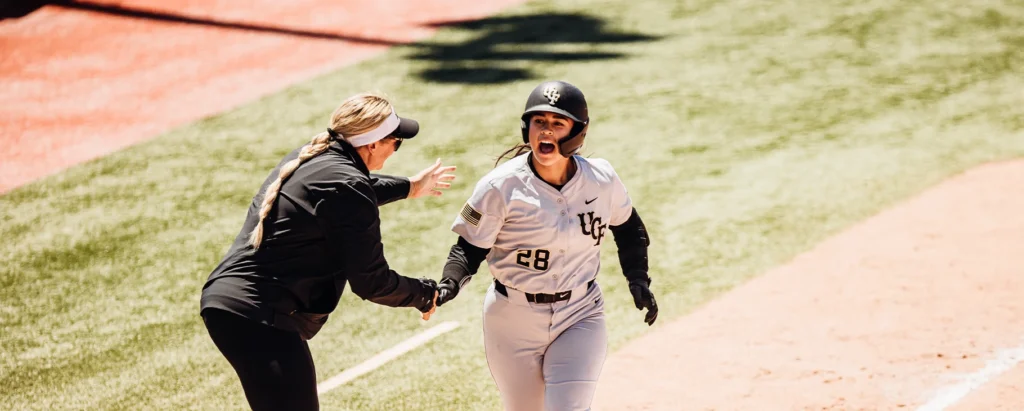
UCF is not sneaking up on anyone anymore. They just finished 2025 at 35-24-1, made the NCAA Tournament for the fifth straight year, and played their way to an Austin Regional Final. That is a real season, not a “we were competitive” season.
Now comes 2026, where the Knights get a schedule with 54 games, 35 at home, and a non-conference slate that is basically a stress test wrapped in sunshine. Head coach Cindy Ball-Malone is entering season eight at UCF, and the program is heading into its third year as a Big 12 member.
Also, the preseason vibe from the league is pretty clear: UCF is not ranked in the ESPN.com/USA Softball preseason Top 25, but they are in the “received votes” group. Translation: you are on the radar, just not invited to the front table yet.
What 2025 actually proved
Start with the part that matters for projecting 2026. UCF did not just stack wins. They stacked wins against people who usually do the stacking.
UCF tied a program record with seven wins over Top 25 opponents, including wins over Florida, Arizona (twice), Missouri, Oklahoma State, Florida Atlantic, and Michigan.
That same season ended with UCF landing No. 24 in D1Softball’s final Top 25, after a postseason that included a Big 12 Tournament win over Utah and two NCAA Regional wins over Eastern Illinois and No. 25 Michigan.
Targeted snark, one sentence: if you beat that many ranked teams and still have to explain yourself, you are learning how college softball works.
The core: the circle is the selling point
If you are looking for the foundation of this team, it’s in the circle.
Isabella Vega is back as a redshirt sophomore RHP, and she is not coming off a “nice freshman year.” She earned Freshman All-America honors from Softball America and D1Softball, and UCF leaned on her in high-leverage moments, including postseason relief work.
UCF’s 2025 season review also notes Vega threw a no-hitter at Kansas and earned Wilson/NFCA National Pitcher of the Week recognition. That tells you what the ceiling looks like when she’s right.
The broader pitching plan matters too, because 2026 is built to demand innings. The roster has multiple arms listed, including Lena Elkins (Sr. RHP), Yessenia Lopez (So. RHP), Macy Miles (RS-Jr. RHP/UTL), plus freshmen like Ava Stuewe and Tori Payne, and a lefty option in Hildie Dempsey (Fr. LHP/OF).
UCF does not need 10 pitchers. They need two or three they trust when the schedule turns into that familiar March blur where every weekend is a “good measuring stick,” and every midweek opponent is trying to make their season on your field.
The lineup: more length, fewer empty innings
UCF’s 2025 identity included comebacks, power, and timely hits, not just one superstar carrying the mail. The season review calls out that nine of UCF’s 35 wins came in games where they trailed in the fifth inning or later, or by three-plus runs. That’s not luck. That’s a lineup that keeps taking at-bats seriously even after it gets punched.
For 2026, the returning position-player group has a workable mix of experience and upside:
Beth Damon (So., C) is a big piece. She earned D1Softball Freshman All-America Second Team honors. Having a catcher with immediate national recognition is not nothing, especially when you are trying to manage a staff and still hit.
Aubrey Evans (Sr., INF) gives veteran steadiness.
Samantha Rey (Jr., INF/OF) and Sierra Humphreys (Jr., INF) are back as everyday options who already lived through Big 12 weekends.
Younger bats like Coco Jaimes (So., INF) and Izzy Mertes (So., UTL) are part of the lineup future, and they were already involved in big moments last season, including regional production mentioned in the season recap.
UCF also has transfer experience sprinkled in. The 2026 roster lists Destiny Washington (Marshall), Kalista Birkenstock (FGCU), and Zoe Calvez (LSU) among players with previous schools attached. That matters because you are not building 35 home games worth of depth with good intentions. You need players who have already handled adult innings and adult at-bats.
The coaching angle: stability is part of the plan
Ball-Malone’s program has been consistent about two things lately: scheduling big and believing the team will grow into it.
UCF’s schedule release lays it out plainly. This is a 54-game campaign, it includes 12 NCAA Tournament opponents, and it features opponents that reached Super Regionals and the Women’s College World Series in 2025, including Florida and Texas Tech.
That’s not accidental. It’s a decision. It also means the early record might not be pretty if the pitching depth and lineup timing are not ready fast.
The schedule: February tells the truth
UCF opens the season hosting the Black and Gold Classic (Feb. 5–8) with Boston, CSU Bakersfield, Duke, Maryland, and Buffalo.
That is a solid opening weekend because it gives you different styles and enough games to start sorting roles.
Then the Knights get right into the deep end at the Shriners Children’s Clearwater Invitational (Feb. 13–15) against Northwestern, Georgia, LSU, Nebraska, and NC State.
That Clearwater slate is not about padding anything. It’s about seeing whether your pitchers can beat quality lineups when scouting reports are real and mistakes get hit hard.
Back home, UCF hosts the SpaceU Classic (Feb. 19–22) with Ohio, Penn State, Notre Dame, and Charleston Southern, then later the Charge On Classic (Feb. 26–March 1) with Dartmouth, Wagner, George Washington, and Florida A&M.
Midweeks that matter:
Missouri (Feb. 11) at home
Florida Atlantic (Feb. 25) at home
FIU (March 18) away
FGCU (March 25) at home
Stetson (April 15) at home
North Florida (April 22) at home
And the Florida series is a clean home-and-home:
at Florida (April 24)
vs Florida (April 25)
No cliche rivalry talk needed. Just circle the dates.
Big 12 play: it ramps quickly and stays that way
UCF’s Big 12 slate is eight series, and there are no soft landings.
Conference schedule (in order):
at Oklahoma State (March 6–8)
vs Baylor (March 13–15)
vs Texas Tech (March 20–22)
at Houston (March 27–29)
vs Utah (April 2–4)
at Arizona State (April 10–12)
vs Kansas (April 17–19)
at Iowa State (May 1–3)
UCF went 12-12 in Big 12 play last season, earned series wins over multiple conference opponents, and got its first-ever Big 12 Tournament win (over Utah). That’s progress that actually shows up in the results.
The Big 12 Tournament is set for May 7–9 at Devon Park in Oklahoma City.
Three things that decide what kind of year this is
1) Can UCF turn Vega into a weekly advantage, not a rescue mission?
She’s proven she can dominate. The next step is having enough support arms so she is freshest when the Big 12 and postseason get tight.
2) Can the offense stay dangerous without living on comebacks?
UCF made a habit of rallying in 2025. That’s a good trait, but you still want more games where you just lead and stay there.
3) Do the home tournaments translate into home-field edge, not just home-field volume?
UCF plays 35 home games. If you are going to schedule like that, you should cash it in.
The fair expectation
UCF has earned “serious program” status. Five straight NCAA trips, a 35-win season in 2025, and multiple ranked wins is not an accident.
For 2026, the most reasonable target is this: be a team that plays itself into the tournament picture early, survives the Big 12 with a real conference résumé, and is still throwing its best stuff in May.
Also, if UCF wants to go from “received votes” to “ranked every week,” the path is boring and very real. Win series in the Big 12, split the big non-conference weekends, and do not give away the winnable midweeks.
It’s not glamorous. It’s just how you climb.